Confidence in practice: enhancing patient support with Me+

Me+ is the patient support programme provided by Convatec. They ran a complimentary pair of webinars about Me+ – one focussing on the patient perspective and one outlining the ways in which healthcare professionals can support their patients to use and learn from Me+. 

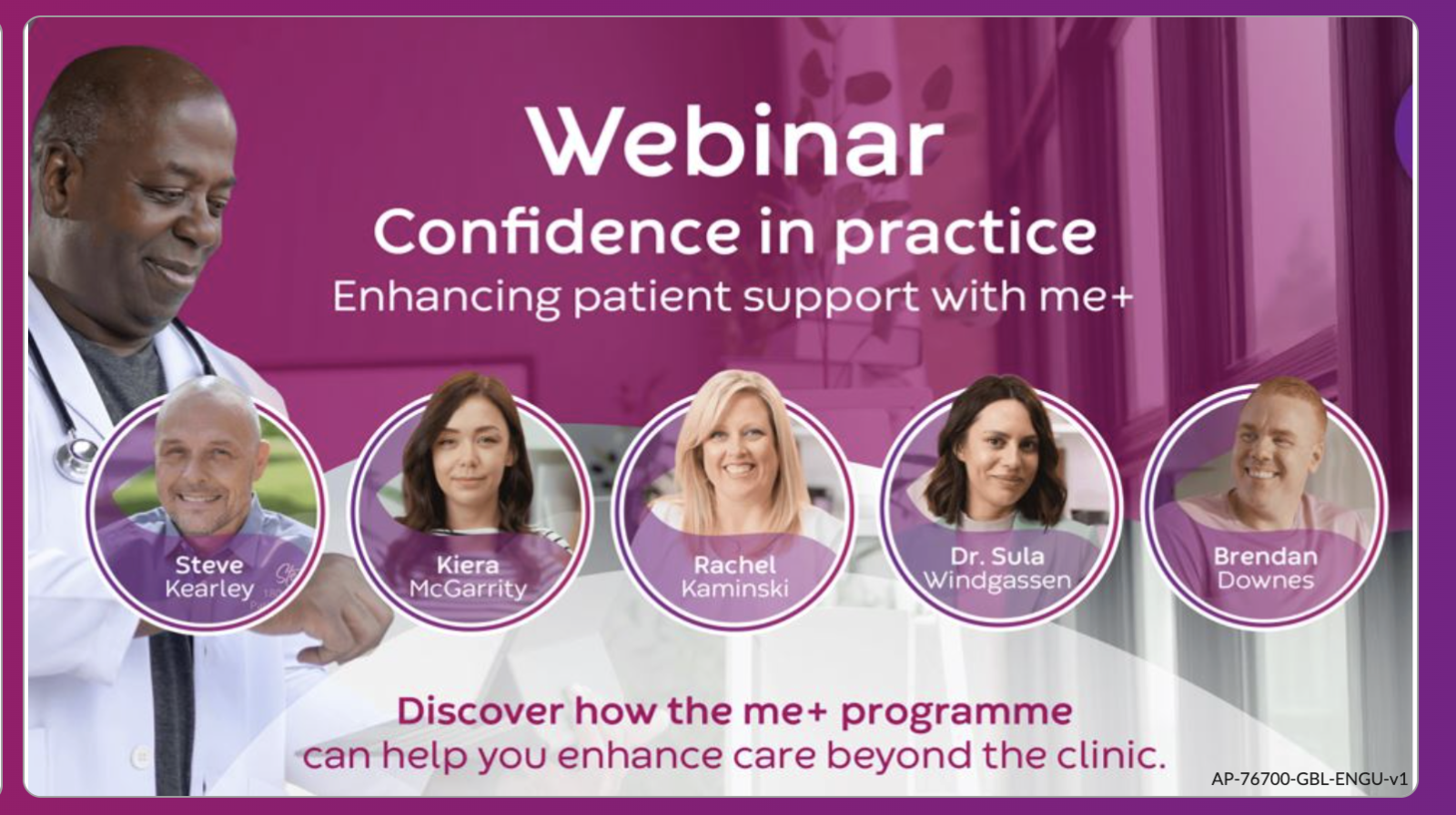
This article discusses the outcomes from the webinar entitled ‘Confidence in practice: enhancing patient support with Me+’, designed to give real-world insights into the challenges that patients face and strategies that can make a difference from the perspective of a clinical psychologist, a registered nurse and intermittent catheter users. The aim was to give viewers practical approaches to strengthen patient communication, foster independence, and provide holistic support through the me+ programme. This webinar can be watched back at https://resources.convatec.com/wcc/eh/4183199/lp/5078153/confidence-in-practice-enhancing-patient-support-with-me

The webinar was hosted by Dr Sula Windgassen, a health psychologist who was heavily involved in developing Me+. The participants were Rachel Kaminski, a nurse working with Convatec, Keira McGarrity, a psychological wellbeing practitioner and intermittent catheter user, Steve Kearley, who has lived with a spinal cord injury and tetraplegia and has been an intermittent catheter user for over 30 years, and Brendan Downes, an intermittent catheter user.
 

Living with chronic conditions


Sula began by introducing a new report produced by Convatec entitled Perspectives on living with chronic conditions. Living with a chronic condition affects far more than just physical health. It shapes relationships, routines and emotional wellbeing. The report brings together stories, data and expert perspectives on how relationships, innovation and care systems help people thrive as they navigate chronic problems. The panel discussed some of the findings of the report and how these related to their experience of intermittent self-catheterisation.

One of the main findings was that 84% of respondents have hidden conditions which may lead to a lack of recognition of needs by healthcare professionals. Keira strongly related to this sentiment, as her condition is invisible and so people don’t realise that she is a catheter user or may be unwell. She said that sometimes she wants to hide her condition whereas at other times she wants people to know about it so that she can get support or empathy from friends or colleagues when she isn’t feeling well. The participants emphasised that it can be difficult when you are struggling if people don’t realise that you have a chronic condition – if you are exhausted or in pain, people don’t recognise why. Steve said that if you have an ‘obvious’ condition, such as a spinal cord injury, then other ‘non-obvious’ conditions tend to be missed or ignored.
Appraising evidence: putting research into practice for nurses
The report also found that 59% of people downplay their physical chronic condition – Keira agreed that she does this via masking to show she is capable. In terms of healthcare consultations, she has learned to present herself in a certain way to be taken seriously. Brendan added that when he is nervous, he masks his condition more than usual. Feeling heard and seen by healthcare professionals increases patients’ confidence in discussing their condition. Participants want healthcare professionals to genuinely listen to patients, and emphasised that a catheter is not just a piece of clinical equipment but is a tool for independence – it allows patients to get on with the other parts of their lives. They also highlighted that when a patient is feeling unwell, it can be harder for them to advocate for themself, which is important as conditions can be misunderstood.
 

Emotional wellbeing


The panel then discussed the findings of a survey of emotional wellbeing, which found that 69% of respondents experienced psychological challenges, including 29% reporting embarrassment. Keira said that she is now much less embarrassed about using a catheter than she was when she was younger. She highlighted that learning about the physical process of catheterising is only a small part of the overall process – the emotional experience was not part of the treatment that she was given and, that for her, the fear of urinary tract infections is real and had a major impact on her concerns about catheterising. The participants emphasised that having an evidence-based reliable source of information was really important for them.

Sula felt that it is better for healthcare professionals to assume that everyone has psychological needs relating to catheterising, as this normalises it and can help make conversations less awkward.

Fear of urinary tract infections is a major worry for patients, so the panel discussed how healthcare professionals can support people with this worry. Steve felt it was important to encourage patients to trial different products and make sure they found one that was right for them.

Brendan advised healthcare professionals to ask questions and check in with patients –some want their condition to be hidden but some don’t. He suggested that these should not just be clinical questions – ask about supply processes, ie do products arrive on time, as this is all part of the management of the condition. Developing confidence in using a catheter takes time – 68% said it took around 3 months before they felt reasonably confident about using their catheter.

Of survey respondents 67% said that they have social difficulties, which included 30% avoiding travel, 28% avoiding social situations, 26% avoiding intimacy and 18% having relationship issues. Sula asked the panel about this – Keira emphasised that the fear of lack of access to a toilet used to impact on her social life. Early on after his injury, Steve avoided going to sporting events because the bathrooms would be crowded and dirty, whereas now he has gained the confidence to attend these.

In terms of the support provided to users, there are gaps in early provision – 82% report feeling unsupported. When asked about the most important information that they needed when they started catheterising, 80% wanted information about how to use a catheter, 30% wanted information on product options, and 30% wanted clarification about ordering processes.

The panel then reflected on a comment from a survey responder when asked their thoughts around having to catheterise. The patient commented:

‘Having to consider hygiene more, take time to catheterise, consider comfort considerations and bathroom facilities when out, carrying a catheter bag around, feeling damaged and broken, considering fluid intake and time catheterising while I’m working.

Why has my body let me down? Leakage and drips on my clothes. Cost considerations. Should I reuse the catheter and risk and infection or decrease fluid intake due to costs? Understanding that I know my body and the right size catheter for comfort.

Being happy I can catheterise standing up as a woman! Learning about my body and the weird angle my urethra goes instead of straight in the middle. I feel weird and unnatural. I’m unhappy but happy for a solution and the sense of relief when I’ve emptied my bladder.

Did that just cost me over $6 to have a wee? Oh the drama of needing this option but how grateful I am that I can still manage to self-catheterise, even with my rheumatoid arthritis I can manage my self-care. Life is still worth living.’

The panel felt that this reflected the dichotomy of being happy but not happy at the same time. Brendan emphasised the statistic that 80% need education about how to use a catheter – there is a finite amount of time that healthcare professionals can spend with patients, and so a progrmme like Me+ really meets this need to support patients. Sula said that patients often struggle to take in information at the first appointment, so having this resource on hand for patients to access when they need is very important.

The Me+ programme


Rachel then discussed the tools developed by Convatec in the Me+ programme. This was developed in collaboration with clinicians from a range of different specialties – urology, spinal cord injury, urogynaecology, neurology – as well as users. The emotional wellbeing programme, educational tools and personalised video guides have been developed to fill gaps in available information and support. The educational tools are targeted at both users and healthcare professionals, and follow the whole patient journey. The first tool is the consultation considerations and guidance for intermittent catheterisation – this is designed to help with training and patient considerations such as positioning, adaptive equipment and features of different catheters which would make them better for different patients.

The intermittent catheterisation consultation checklist is the aspect of Me+ most valued by healthcare professionals. This can be used before, during and after training, for competency assessment and as guidance when teaching patients. It covers all aspects of the patient – physical wellbeing, lifestyle, holistic wellbeing and socioeconomic aspects.

Another tool is the intermittent catheterisation clinical practice principles which every patient should have when they are preparing to learn about intermittent catheterisation. These are divided into three sections: pre-treatment, initial catheter selection, and the lifespan of intermittent catheter use. 

Sula outlined the Me+ emotional wellbeing programme which includes a framework of how to have conversations with patients around the more holistic areas of catheterisation. Healthcare professionals are often concerned about how to address these areas with patients. The framework suggests that clinicians should ask, validate and empower.

There are 10 modules of the emotional wellbeing programme for patients to work through. These move from specific fears and experiences around catheterising and the impact these have had on them to the mind–body interaction and how the psychological elements may be affecting their physical experience of catheterising and their broader wellbeing. The programme helps patients increase their confidence in catheterising via behavioural aspects taken from cognitive behavioural therapy, which can illustrate how anxiety about catheterising can manifest in the body and how they can use the programme to overcome this anxiety. Modules provide stepping stones to take patients through this process, and learn how to move themselves away from beliefs that are affecting their emotional wellbeing, but the programme is not linear – patients can move back and forward between modules as they need.

Rachel outlined the personalised video guides which offer support for new and experienced people. The programme is evidence based and can be used by the patient when and where they need to access the information.

Panel feedback on the Me+ resources emphasised that the number of frequently asked questions in the programme demonstrates the breadth of questions and breadth of needs for patients. Brendan said this programme flattens the learning curve for patients, and Keira emphasised that Me+ gives patients a path to follow rather than having to work everything out for themselves.

Patients can be enrolled into Me+ so they get regular updates on content and access to the resources. The programme is product agnostic, so can be used by patients using any type of catheter.

At the end of the webinar, the panel responded to some questions from attendees.
What piece of advice would the panel give healthcare professionals working with new catheter users?

Brendan began by emphasising that this is not a one-time conversation, so healthcare professionals must not forget about the person. The patient may tend to hide any issues they are having initially, so healthcare professionals should be aware of this and ask questions to make it easier for patients to discuss any problems. Steve asked healthcare professionals not to assume that the catheter that they are teaching the patient to use is the best catheter for that patient. Everyone has unique needs, so offer variety and look at features and benefits of different products. Keira added that the practical side of learning to catheterise is just one part of it and clinicians need to acknowledge the other aspects: the emotional side, confidence, fears and anxiety. Steve encouraged both patients and providers to continually educate themselves about catheters, eg new technology and product differences.
 
Is there a point when you felt particularly supported or unsupported by a healthcare professional and what made the difference?

At the age of 17 years Steve was wearing a leg bag with a Foley catheter which he hated. His healthcare professional told him he wouldn’t be able to catheterise himself because of his injury and issues with his dexterity, but he asked for the chance to try and she supported him to do that. Steve emphasised that letting patients try something even if they fail is vital – give them a choice.  Keira highlighted that feeling heard is so important. Her pain wasn’t typical for someone of her age, and she found that having this pain acknowledged and treated was extremely validating.