From Uncertainty to Confidence: Real People, Real Stories, Real Support with me+
Convatec ran a series of webinars looking at Me+ – this webinar was targeted at people who use intermittent catheters. It was hosted by Dr Sula Windgassen, a health psychologist and psychotherapist who was heavily involved in developing Me+, alongside Keira McGarrity, a psychological wellbeing practitioner and intermittent catheter user, Steve Kearley, who has lived with a spinal cord injury and tetraplegia and has been an intermittent catheter user for over 30 years, and Brendan Downes, an intermittent catheter user. The webinar is available to watch back at https://resources.convatec.com/wcc/eh/4183199/lp/5078155/from-uncertainty-to-confidence-real-people-real-stories-real-support-with-me
Living with chronic conditions
Sula began by outlining some of the key findings from Convatec’s Chronic Conditions report. Many chronic conditions remain invisible – 1 in 3 live with a chronic physical condition but 84% of these are hidden to other people. Masking is common – 59% of those with chronic conditions downplay their condition to make other people feel more comfortable. There is less awareness of some chronic conditions – 91% report some familiarity with cancer, whereas only 49% know about ostomy or continence conditions. Advocacy is important – 43% of respondents said that they had to advocate for themselves in healthcare settings because their condition is misunderstood or minimised.
Sula asked the panel for their thoughts on these findings. Brendan said he recognises hiding his condition, though more so when he was younger, and emphasises the importance of self-advocacy – pushing for medical devices that can better manage his condition. Steve recalled, when he was younger, asking his healthcare professional if he could transition to self-catheterising. She initially said no because of his lack of dexterity, but he persisted and she supported him doing that and with the right product and support he has been self-catheterising since he was 17. He felt it helps him both from a health and a quality-of-life perspective. He felt it helps him both from a health and a quality-of-life perspective.
Brendan pointed out that trial and error is an important part of this – whether it relates to devices, techniques or other aspects of care – and that asking for options is very important. Catheters aren’t just medical devices – they are a lifeline to independence for users – but each person needs to advocate for their own variables that matter to them. Keira said it has taken her years to advocate for herself – she developed her own methods of feeling comfortable to discuss her condition with healthcare professionals.
Impact of social stigma
The panel discussed the effect of social stigma on those with either a visible or invisible chronic condition. Steve uses a wheelchair so his condition is very visible. He used to try and time it so he only catheterised at home but is now comfortable catheterising in any public bathroom. Brendan said it can depend on your age and where you are in the spectrum of progressing with the process of catheterising. When he was at school, he kept his supplies in the nurse’s room and catheterised there so that he didn’t have to use the school bathrooms. However, he emphasised that friends and family will just adapt and wait for you if you’re catheterising while you are out and about, as they just want you at the event with them. Keira faced two sides of social stigma – when she was younger she just wanted to be like her friends, so went to extreme lengths to hide the fact that she was in pain. The other side was that when she first presented to the doctor, she was told that she was too young and she really had to justify why she was there. She went from trying to hide her symptoms to trying to prove her symptoms – a tough balance.
Sula highlighted the intuitive human wish to hide something because it is different and might be disapproved of, whereas we are unlikely to be judged by people who matter to us. The panel noted that if someone does judge you by the way you use the bathroom, they’re not likely to be someone you want as a friend.
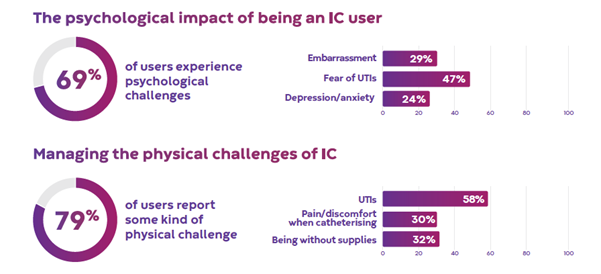
Sula then moved on to look at the emotional wellbeing survey. In 2025, Convatec conducted a survey of 232 people using intermittent catheters across Australia, France, Italy, the USA and the UK to better understand the realities of life with intermittent catheters, emotionally, physically, and socially. The survey found that 69% of respondents experienced psychological challenges, including 29% reporting embarrassment, 47% fear of UTIs and 24% depression and anxiety (Figure 1). The survey also found that 79% of respondents reported some kind of physical challenge.
Sula asked the panel if this matched their experience. Steve used to feel like he constantly had a UTI – because of his dexterity problems, he was transferring bacteria to his urinary tract while catheterising, so it was only when he found products that he was more able to use that this reduced the impact on his urethra so he had fewer UTIs –he now has them very infrequently. Keira agreed – she felt like she was constantly having UTIs, and that using catheters was making her sick, which felt wrong to her as they were meant to be making her less unwell. She struggled to use a catheter initially but now is comfortable using them. Brendan encouraged viewers that it is worth persisting to work out the process and product that works for you and that it will get to the point where you almost don’t think about the process of catheterising. He highlighted that if something within the process isn’t comfortable, you are the only person who knows that, so you have to advocate for yourself to improve this by asking about the range of options available so you can try other types.
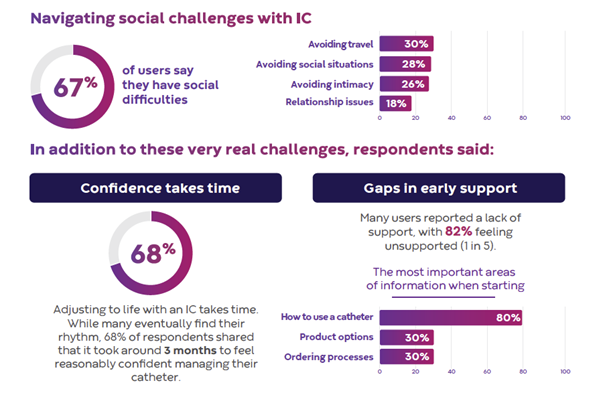
The next set of results looked at social challenges (Figure 2), confidence and gaps in early support. A shocking 82% of users felt unsupported early in the process of learning to catheterise. Steve emphasised the need to take small steps and see these as a means of achieving the next step. Brendan noted the importance of understanding that this is a major change for your body in terms of changing how you do something. Before you start using intermittent catheters, you will have urinated a different way for all your life, so it’s not surprising that it will take you a little time to adjust to the new processes so this becomes the new normal.
A woman in Australia responded to the survey with the following feedback:
‘Having to consider hygiene more, take time to catheterise, consider comfort considerations and bathroom facilities when out, carrying a catheter bag around, feeling damaged and broken, considering fluid intake and time catheterising while I’m working.
Why has my body let me down? Leakage and drips on my clothes. Cost considerations. Should I reuse the catheter and risk an infection or decrease fluid intake due to costs? Understanding that I know my body and the right size catheter for comfort.
Being happy I can catheterise standing up as a woman! Learning about my body and the weird angle my urethra goes instead of straight in the middle. I feel weird and unnatural. I’m unhappy but happy for a solution and the sense of relief when I’ve emptied my bladder.
Did that just cost me over $6 to have a wee? Oh the drama of needing this option but how grateful I am that I can still manage to self-catheterise, even with my rheumatoid arthritis I can manage my self-care. Life is still worth living.’
Sula reflected that this quote reflects the dichotomy of this situation – the woman can now catheterise standing up but still struggles with other aspects of catheterising.
Just because the healthcare professional provides you with or demonstrates with a product that they are happy using, doesn’t mean it will be the best product for you. A lot of patients have the process demonstrated once in the healthcare setting and are then just given the product and told to go and get on with it. Steve said that it’s such a life change that patients need support to learn about and adjust to the process of catheterising, but the panel emphasised that using a catheter will become an almost automatic process with time.
The Me+ programme
Sula then outlined the Me+ programme which has been developed specifically to support patients. It includes educational tools, an emotional wellbeing programme and personalised video guides.
The educational tools are guides and videos tailored to your catheter journey, helping you understand devices, technique, and daily life, including a set of documents – An introduction to intermittent catheterisation, Intermittent catheterisation and you to help you personalise your catheterisation process, and Making intermittent catheterisation work for you which looks at how you can discuss this with your healthcare provider. The emotional wellbeing programme is a series of 10 video modules plus a workbook focused on coping with the emotional impact of life with a catheter. This recognises the emotional load of using catheters, how you adjust to the change in your life and the social side of this, and develop emotional coping tools. The personalised video guides are interactive content to build confidence and match your specific catheter routine. These guides are brand agnostic, so can be used by anyone regardless of whether or not they are using Convatec products.
When discussing the Me+ programme, the panel felt that both new and longer term users will benefit from the dual aspect of supporting both the practical side of learning to self-catheterise but also the emotional impact of this. As Me+ is self-guided you can take it at your own pace, focus on what matters to you at a time that suits you, and that you can go back to whichever part(s) of the programme that you need whenever you need to.
Questions to the panel
Q My family don’t know that I catheterise – how do I begin to explain?
A The panel suggested that in this situation, you can use Me+ resources to understand the process and then put it into your own language, pick one or two ‘safe’ people to talk to first, or sending your family specific resources for them to read first and then happy to discuss. You may not need to tell everybody everything – awareness that you use a catheter might be sufficient. Sula emphasised that it is worth thinking about who you ‘want’ to tell – do you feel socially safe to do that? What is the risk to you of sharing this information?
Q I’m new to catheterising – do you think people's perception of catheterising is improving?
A Keira felt that she’s had more judgement from herself than from others. Steve mentioned that developments in technology makes it less concerning about catheterising – the perception is that it’s easier to do. Brendan encouraged people to ‘join us’ and be part of the change in public awareness and perception. Come and feel part of the community.
You need to be logged in to subscribe to a journal. Please login to make use of our journal subscription feature.
.jpg)
 Contact us