Understanding the different generations of catheters

Like most medical devices, the design and features of catheters have developed over time.

Mass-produced catheters became available in the mid-19th century thanks to the development of vulcanized rubber by Goodyear (University of Southampton, 2026).

In the early 1970s, intermittent catheterisation grew in popularity when it was seen that catheters could safely be used to drain the bladder as needed in clean rather than sterile conditions without causing infections (Lapides et al, 1971). Since then, millions of people worldwide have been able to independently manage bladder conditions using 'clean intermittent catheterisation'.


Understanding the different generations of catheters

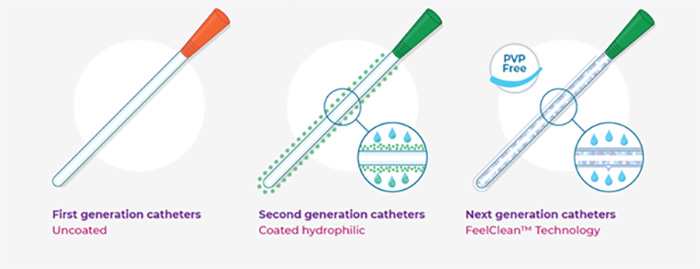
First- and second-generation catheters


When clean intermittent catheterisation was introduced, it was performed using a water-based lubricant and plain, plastic or rubber catheters that were washed and used many times – first generation catheters. Later, catheters intended for single use were developed and these are now the norm in the UK. These single-use catheters are usually either packaged pre-coated in a lubricating gel, or have a hydrophilic coating that becomes slippery when soaked in water for a short period. These are the second-generation catheters. The downside of these coatings is that they dry out with use, which can cause them to stick to the lining of the urethra, and they can also be messy to use.
 

GentleCath: the third generation


The third generation of catheter is the GentleCath™ range from Convatec which uses FeelClean™ technology. This is the first and only catheter where the slippery hydrophilic properties are integrated inside the catheter itself rather than having a sticky coating.

Without this coating, GentleCath with FeelClean technology does not stick, causing up to 53% less damage (Burns et al, 2025) than leading catheter brands on the market. This protects the delicate urethra (Pollard et al, 2022), the body’s first line of defence against urinary tract infections (Dellimore et al, 2013).

References


Burns J, Irwin RN, Quinn J et al (2025) An ex-vivo porcine urethral model for investigating intermittent catheter-associated urethral microtrauma. Materials & Design. 259:114727. https://doi.org/10.1016/j.matdes.2025.114727  

Dellimore KH, Helyer AR, Franklin SE (2013) A scoping review of important urinary catheter induced complications. J Mater Sci Mater Med. 24(8):1825-1835. https://doi.org/10.1007/s10856-013-4953-y  

Lapides J, Ananias CD, Silber SJ, Lowe BS (1972) Clean intermittent self catheterisation in the treatment of urinary tract disease. J Urol. 107:458-61  

Pollard D, Allen D, Irwin NJ, Moore JV, McClelland N, McCoy CP (2022) Evaluation of an integrated amphiphilic surfactant as an alternative to traditional polyvinylpyrrolidone coatings for hydrophilic intermittent urinary catheters. Biotribology. 32:100223. https://doi.org/10.1016/j.biotri.2022.100223  

University of Southampton (2026) The history and development of Intermittent https://www.southampton.ac.uk/multicath/about-the-study/the-history-and-development-of-ic.page  (accessed 27 March 2026)