Urinary tract infections in older women: how to avoid misdiagnosis and inappropriate treatment

As around 40% of women treated with an antibiotic do not have a confirmed urinary tract infection, Linda Nazarko highlights the importance of understanding the diagnosis, differential diagnoses and treatment in older women.

Key words: Urinary tract infection, older women, diagnosis, treatment, antimicrobial resistance
 

Introduction


In England 200 000 people were admitted to hospital with a urinary tract infection (UTI) in the 2023–24 financial year (UK Health Security Agency, 2025a). According to these figures, 52.7% of people admitted for UTI were aged over 70 years and the percentage of women admitted ranged from 50.8% of the 60–69-year age group to 60.8% of those aged over 90 years of age. The average length of stay was 6 days (UK Health Security Agency, 2025a). The NHS in England used 1.2 million bed days and spent £604 million on treatment in that 1-year period (UK Health Security Agency, 2025a). Misdiagnosis is common and around 40% of women in the UK treated with an antibiotic do not have a confirmed UTI (Lim et al, 2014).
 
Misdiagnosis of another condition as a UTI means that the problem that led to admission is not identified and treated. Misdiagnosis and inappropriate antibiotic treatment increase the risk of antimicrobial resistance developing and can lead to the person suffering a range of adverse effects including gastrointestinal symptoms and fungal infections. This article outlines the diagnosis of lower UTI, alternative diagnoses, and the management and treatment of uncomplicated lower UTIs in women aged 65 years and over.

Why older women are at increased risk of urinary tract infection

 
A lower UTI is defined as: ‘An infection of the bladder (also known as cystitis) usually caused by bacteria from the gastrointestinal tract’ (National Institute for Health and Care Excellence, 2025).

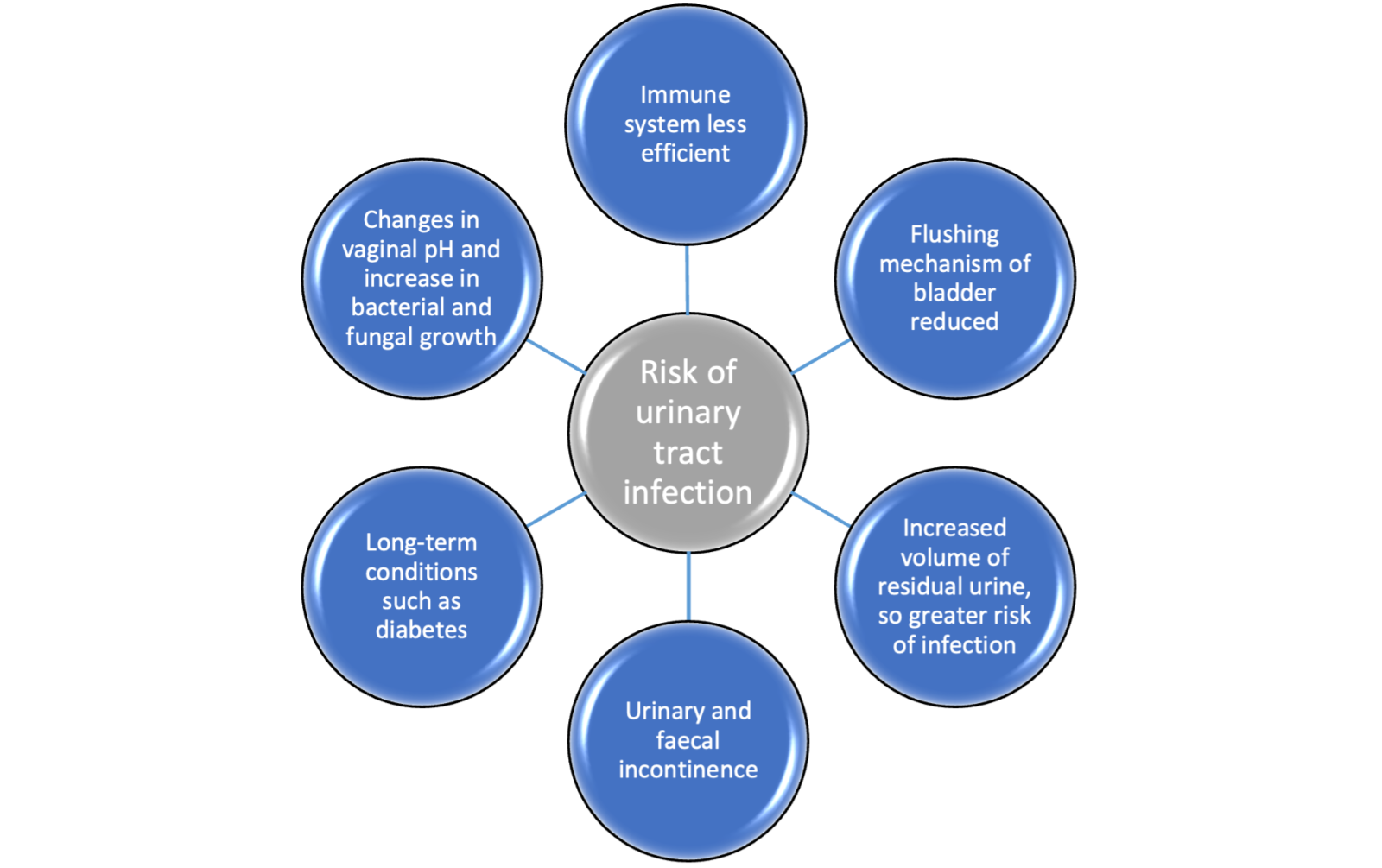
The risk of UTI is increased in women because the urethra is only 5 cm long, whereas it is 15 cm long in men, meaning it is easier for bacteria to reach the bladder in women (Tan and Chlebicki, 2016). The risk of a woman developing a UTI rises with age as a result of age-related changes to the bladder and vaginal pH and the increased prevalence of long-term conditions, such as diabetes, that increase the risk of infection (Ahmed et al, 2018).

Around 10% of women aged 65 years and over and almost 30% of those aged 85 years and over report having had a UTI in the last year (Rowe and Juthani-Mehta, 2013). It is difficult to accurately measure the incidence of UTI because of a lack of standard criteria and difficulty differentiating UTI from asymptomatic bacteriuria (Rowe and Juthani-Mehta, 2013). Ageing decreases both bladder capacity and sensitivity to bladder fullness. In young people the bladder is like a balloon – it is stretchy, enlarges well and empties fully. The acidity of urine and the strong flushing mechanism of a healthy young bladder prevent bacteria from adhering to the bladder wall and protect against infection. As adults age the amount of fibrotic tissue in the bladder wall increases, so the bladder becomes less stretchy and holds less urine. It also contracts less efficiently which increases the volume of residual urine (the amount of urine left in the bladder after urinating). This pool of residual urine can be a breeding ground for bacteria and can therefore increase the risk of infection (Storme et al, 2019).
 
Until menopause the pH of the perineum and vagina is acidic, which inhibits the growth of Enterobacteriaceae such as Escherichia coli and Proteus spp., and fungi. Hormone levels fall with age and lead to changes in the pH of the vagina. It becomes alkaline rather than acidic, the bacterial flora change and there is increased colonisation of Enterobacteriaceae and fungi, all of which increase the risk of genitourinary infection (Ferrando et al, 2026).

Ageing and long-term conditions which are more prevalent in older people affect the immune system and increase vulnerability to infection (Ligon et al, 2023). Figure 1 illustrates how ageing increases the risk of a woman developing a urinary tract infection.
Figure 1. Age-related changes in women that can increase the risk of a urinary tract infection developing.

Figure 1. Age-related changes in women that can increase the risk of a urinary tract infection developing.
 

How diagnosing a urinary tract infection differs in older women


Healthy young women do not normally have pre-existing lower urinary tract symptoms. National Institute for Health and Care Excellence (2025) advises that women under the age of 65 years can be diagnosed with a UTI if they have two or more of three key urinary symptoms (dysuria, new nocturia and visibly cloudy urine) and no other excluding causes or warning signs. Table 1 outlines clinical features of a UTI in women under 65 years of age.
Table 1. Clinical features of urinary tract infection in women under the age of 65 years
Key features New nocturia
Cloudy urine
Dysuria
Other features Urinary frequency
Painful frequent passing of only small amounts of urine
Haematuria
Foul-smelling and/or cloudy urine
Urgency
Urinary incontinence
Suprapubic or loin pain
Rigors
Pyrexia
Nausea and/or vomiting

There are a number of reasons why a woman aged 65 years and over may have lower urinary tract symptoms. These include medication used to treat long-term conditions, such as diabetes, and age-related changes. In a woman over 65 years of age, a diagnosis of UTI should be considered if there is isolated new-onset dysuria or two or more urinary or non-specific symptoms. Table 2 outlines urinary and non-specific symptoms in women over 65 years of age (National Institute for Health and Care Excellence, 2025).
 
Table 2. Specific features of urinary tract infection and non-specific symptoms in women over the age of 65 years (based on National Institute for Health and Care Excellence, 2025)
Urinary symptoms New onset dysuria
New frequency or urgency
New urinary incontinence
New suprapubic pain
New visible blood in the urine
Non-specific symptoms Fever
New or worsening delirium – if delirium is the only symptom consider other underlying causes
New or worsening general malaise, lethargy, and reduced daily functioning – may be a sign of underlying infection if there is no alternative diagnosis to account for symptoms

Diagnostic pitfalls


Older women who are in good health are likely to seek treatment in primary care or in NHS walk-in centres when they develop symptoms of a lower UTI. Most (85.7%) are prescribed antibiotics on presentation (Pujades-Rodriguez et al, 2019). The European Association of Urology (2023) recommend that clinicians take a complete medical history, including symptoms and comorbidity, and perform a focused physical examination when women present with lower urinary tract symptoms. However, in clinical practice antibiotics may be prescribed on the basis of telephone consultations. Primary care is responsible for prescription of around 70% of antibiotics (UK Health Security Agency, 2025b).
 
Research looking at the diagnosis and treatment of UTI in women under the age of 65 years took place with eight focus groups involving 57 members of staff who worked in GP surgeries in two English clinical commissioning groups. The researchers found that many telephone consultations were carried out, mostly by nurse practitioners, to manage patients who had a suspected UTI. During the telephone consultation, some clinicians asked for a urine sample to be brought in, but others considered this unnecessary. The researchers found that GP staff including nurse practitioners required further education and training. They also found that patients with urinary symptoms expected antibiotic treatment. The researchers recommended public antibiotic campaigns and provision of patient-facing information regarding UTIs, non-pharmaceutical recommendations for ‘self-care’ and prevention of UTIs and rationale for 3-day-long antibiotic courses. They also recommended that practices audit their UTI management (Cooper et al, 2020). The resources section below gives details of UTI audits and patient information leaflets.
 
Older women who have health problems or who are frail may receive care and support from family, homecare services, care home staff and community nurses. Family and professional care givers may request antibiotics on behalf of the person for a UTI. Reasons for such requests include smelly urine, strong urine, cloudy urine, urinary incontinence, nocturia, increased confusion or generally off colour in people with a diagnosis of dementia, or new confusion in people who are not normally confused.
 
Urine that is described as ‘strong’ may indicate that the person is dehydrated. Older people are more vulnerable to developing dehydration as a result of age-related changes that lead to reduced blood flow to the kidneys, reduced ability to filter and to concentrate urine (Nguyen and Goldfarb, 2012; Andrade and Knight, 2017). Increasing fluid intake may resolve any issues. These age-related changes mean that it is normal for older people to have to wake up in the night to pass urine. At the age of 85 years an adult normally has to wake up twice a night to pass urine because the body produces more urine at night and the bladder is smaller than when they were younger.
 
Urine that is described as cloudy, smelly or tests positive for nitrites, leucocytes and red blood cells is indicative of a UTI in a younger woman; however, urine tests are not helpful in identifying infection in older women and should not be used to diagnose UTI in older women because of the high levels of asymptomatic bacteriuria (National Institute for Health and Care Excellence, 2025). Residual urine increases with age often becomes colonised with bacteria, known as asymptomatic bacteriuria. This is generally harmless and these women have no symptoms of infection. Asymptomatic bacteriuria is more prevalent in frail older women living in care homes and affects around 40% of older women (Biggel et al, 2019). It is often inappropriately treated because staff use urine tests inappropriately in older people to diagnose UTI despite National Institute for Health and Care Excellence (2025) guidance advising that this should not be done, exposing the individual to the hazards of antibiotic therapy and leaving any presenting problem untreated (Nicolle, 2024).
 
In order to diagnose UTI staff should follow UK Health Security Agency and NHS England (2025) guidance outlined in the diagnostic decision tool at https://assets.publishing.service.gov.uk/media/684180a358bd5a53d0211cd2/DDT_over_65_A3.pdf.
 
Care givers and clinicians may consider that increased confusion in people who have dementia is caused by a UTI, although National Institute for Health and Care Excellence (2025) recommends that a UTI is not diagnosed solely on the basis of increased confusion. Clinicians can use the 4AT tool (available as an app) to identify possible delirium (NHS Scotland, 2025). There are many causes of delirium and UK Health Security Agency and NHS England (2025) recommend the use of the ‘PINCH ME’ tool (Pain, Infection, Nutrition, Constipation, Hydration, Medication, Environment) to assess for causes (British Geriatrics Society, 2020).

The importance of assessment


It is important to exclude other possible causes of urinary symptoms such as medication, obesity, age-related changes to the urinary system or undiagnosed disease. Clinicians should check for any new signs of pyelonephritis, systemic infection, or risk of suspected sepsis (National Institute for Health and Care Excellence, 2024).
 
Those aged 75 years or over, frail older people and those with impaired immune systems are at increased risk of sepsis (Gentile et al, 2014). Sepsis is defined as ‘a dysregulated host response to an infection associated with life-threatening organ dysfunction’ (Singer et al, 2016). Certain infections, such as pneumonia and UTIs, are more likely to trigger sepsis than other infections but it is not clear why (Daniels and Nutbeam, 2024). National Institute for Health and Care Excellence (2024) guidance on sepsis recommends that clinicians working in acute hospitals, acute mental health settings or the ambulance service use the national early warning score (NEWS2) to assess people with suspected sepsis aged 16 years or over who are not or have not recently been pregnant. Early warning scoring systems were initially developed to enable hospital-based nurses and junior medical staff to recognise acute physiological deterioration and to use a trigger threshold to rapidly obtain experienced help. National Institute for Health and Care Excellence (2024) and UK Health Security Agency and NHS England (2025) guidance states that clinicians in community settings should consider using an early warning score to assess adults with suspected sepsis, although the Royal College of General Practitioners (2019) require research evidence on the suitability of any early warning score for use in primary care before they can consider recommending its widespread uptake in general practice. New confusion is a red score that may indicate sepsis (Royal College of Physicians, 2017).
 
The clinician should also check for urethritis – symptoms include a more frequent urge to urinate, pain and burning on urination, and irritation in the urethral area. The primary cause is gonococcal infection, although this can also be caused by trichomonas infection or non-infective causes such as vigorous sexual intercourse, vaginal dryness secondary to atrophic vaginitis, use of bubble baths or feminine hygiene sprays (Young et al, 2024).

Treatment


The first-line treatment for UTIs is trimethoprim or nitrofurantoin, and 3-day courses are recommended to treat uncomplicated UTI. There are no specific recommendations regarding duration of treatment for older women (National Institute for Health and Care Excellence, 2018, 2025). A Cochrane review concluded that ‘short‐course treatment (3 to 6 days) could be sufficient for treating uncomplicated UTIs in elderly women, although more studies on specific commonly prescribed antibiotics are needed’ (Lutters and Vogt‐Ferrier, 2008). Table 3 outlines first- and second-line treatments for UTIs.
 
Table 3. Treatments for urinary tract infection
Based on National Institute for Health and Care Excellence (2018); European Association of Urology (2023); UK Health Security Agency (2025b)
 
Treatment phase Medication Dose and duration Comments
First-line treatment Nitrofurantoin 100 mg modified release twice daily for 3 days Narrow-spectrum agent with low rate of resistance – 2.2%. Not suitable for patients with an estimated glomerular filtration rate <45 ml/min/1.73 m2. Efficacy is reduced when taken concurrently with over-the-counter urinary alkalinising remedies containing citrate
Trimethoprim 200 mg twice daily for 3 days First-line treatment option. Narrow-spectrum agent. Dose adjustments required in patients with renal impairment. High rate of resistance – 30.1%
Second-line treatment Amoxicillin 500 mg three times daily for 3 days Second-line treatment option but high rate of resistance in Escherichia coli (46%) so only suitable for targeted treatment
Fosfomycin Single dose of 3 g Second-line treatment option, with resistance rates 3.6%. Useful for targeted treatment against organisms sensitive to fosfomycin. European Association of Urology (2023) recommends as first- line treatment rather than trimethoprim. Broad-spectrum agent
Pivmecillinam Adult (body weight 40 kg and above): loading dose of 400 mg then 200 mg three times a day for 3–5 days Second-line treatment option which is useful for targeted treatment against organisms sensitive to pivmecillinam. Narrow-spectrum agent. European Association of Urology (2023) recommends as first-line treatment
 
UTIs should only be treated with fluoroquinolones, such as ciprofloxacin, when antibiotic sensitivities mean that no other antibiotics can be used because of increasing antimicrobial resistance and evidence of severe and irreversible toxicity associated with use of fluoroquinolones (Medicines and Healthcare Products Regulatory Agency, 2024).

Prudent antibiotic prescribing


Around 70% of all antibiotics are prescribed in primary care and UTI is the second most common cause of antibiotic prescribing (Dolk et al, 2018; UK Health Security Agency, 2025b). The number of older people diagnosed with UTIs is increasing (Ahmed et al, 2018). Around 100 000 antibiotic prescriptions are issued by GPs in England every day and at least 20% of these are unnecessary (Smith et al, 2018; Palin et al, 2019).
 
There are a range of effects of misdiagnosis of UTIs and inappropriate treatment with antibiotics. A woman with lower urinary tract symptoms may not have her symptoms investigated and treated, and may also be unnecessarily exposed to adverse effects of antibiotic therapy which range from fungal infection to life-threatening infections such as Clostridioides difficile (National Institute for Health and Care Excellence, 2025). Inappropriate prescribing also increases the risk of antibiotic resistance (Mahmood et al, 2022).
 
The numbers of antibiotic-resistant infections and related deaths are rising in England. The English surveillance programme for antimicrobial utilisation and resistance report for 2024–25 showed a rise in resistant bacteraemia and a widening inequality gap between the most and least deprived communities. It reported an average of nearly 400 new cases of antibiotic-resistant infections each week, 20 484 cases in 2024. There were 2379 deaths linked to antibiotic-resistant infections in 2024 (UK Health Security Agency, 2025b).

Future therapies


Until last year, it had been 30 years since a new antibiotic had been developed to treat UTIs. The Medicines and Healthcare Products Regulatory Agency (2025a) approved gepotidacin (brand name Blujepa) – a new type of oral antibiotic that works by targeting and blocking two enzymes that bacteria need to replicate and multiply. It is effective at treating antibiotic-resistant bacteria and is at least as effective as nitrofurantoin.
 
Common side effects include nausea and diarrhoea. Gepotidacin can affect heart rhythm by prolonging the QT interval so should not be used in patients with related issues Medicines and Healthcare Products Regulatory Agency, 2025b). Women and older people may be more susceptible to drug-associated effects on the QT interval (Medicines and Healthcare Products Regulatory Agency, 2025b). Gepotidacin should be available by mid-2026.

Conclusions


Older women are not a homogenous group – some may be fit and well while others may be frail and vulnerable. The nurse can assess the individual and use clinical judgement to determine the appropriate treatment for that person.
 
It is important that we improve diagnosis rates and prescribe antibiotics prudently to improve quality of care. This can be difficult when family members, care givers and nurses are not fully aware that there are many possible causes for urinary and other symptoms and that antibiotics are not always the answer. Readers may find the UTI patient leaflets listed in the resources section below helpful in improving understanding and reducing pressures to prescribe.
 
Nationally there is a pressing need for an education campaign to educate the public and professionals on how UTI is diagnosed and treated. This could reduce unnecessary requests for treatment of asymptomatic bacteriuria and free up clinician time to assess people with urinary symptoms.
 

Key points

  • Older women are at increased risk of developing urinary tract infections as a result of age-related changes such as less effective bladder emptying.
  • Asymptomatic bacteriuria is common in older women and should not be treated with antibiotics.
  • Urine dipstick tests should not be used on their own to diagnose UTI in older women.
  • When treating women with suspected UTI, it is important to consider alternative diagnoses and provide appropriate treatment.

Resources


Toolkit
TARGET – Treat Antibiotics Responsibly, Guidance, Education and Tools – is a toolkit designed to support primary care clinicians to champion and implement antimicrobial stewardship activities https://elearning.rcgp.org.uk/course/view.php?id=553
 
Reference materials
Quick reference materials from UK Health Security Agency and NHS England for primary care on diagnosing and understanding culture results for urinary tract infections https://www.gov.uk/government/publications/urinary-tract-infection-diagnosis/diagnosis-of-urinary-tract-infections-quick-reference-tools-for-primary-care
 
Audit tool
Royal College of General Practitioners UTI 65+ audit tool
https://elearning.rcgp.org.uk/pluginfile.php/172231/mod_book/chapter/454/Over%2065s%20UTI%20audit%20V2.docx
 
UTI patient leaflets
https://www.target-webinars.com/wp-content/uploads/2016/08/UTI-Leaflet-V16.pdf
https://www.wmic.wales.nhs.uk/wp-content/uploads/2024/06/UTI-final-English.pdf
https://patient.info/kidney-urinary-tract/urinary-tract-infections
 
Leaflets in different languages
http://elearning.rcgp.org.uk/mod/book/view.php?id=12647&chapterid=443

References

Ahmed H, Farewell D, Jones HM, Francis NA, Paranjothy S, Butler CC (2018) Incidence and antibiotic prescribing for clinically diagnosed urinary tract infection in older adults in UK primary care, 2004-2014. PLoS One. 13(1):e0190521. https://doi.org/10.1371/journal.pone.0190521

Andrade M, Knight J (2017) Anatomy and physiology of ageing 4: the renal system. Nursing Times. 113(5): 46-49

Biggel M, Heytens S, Latour K, Bruyndonckx R, Goossens H, Moons P (2019) Asymptomatic bacteriuria in older adults: the most fragile women are prone to long-term colonization. BMC Geriatr. 19(1):170. https://doi.org/10.1186/s12877-019-1181-4

British Geriatrics Society (2020) End of Life Care in Frailty: Delirium. https://www.bgs.org.uk/end-of-life-care-in-frailty-delirium (accessed 5 January 2026)

Cooper E, Jones L, Joseph A et al (2020) Diagnosis and management of UTI in primary care settings-a qualitative study to inform a diagnostic quick reference tool for women under 65 years. Antibiotics (Basel). 9(9):581. https://doi.org/10.3390/antibiotics9090581

Daniels R, Nutbeam T (2024). The sepsis manual. 7th edition. https://sepsistrust.org/wp-content/uploads/2024/07/Sepsis-Manual-7th-Edition-2024-V1.0.pdf (accessed 5 January 2026)

Dolk FCK, Pouwels KB, Smith DRM, Robotham JV, Smieszek T (2018) Antibiotics in primary care in England: which antibiotics are prescribed and for which conditions? J Antimicrob Chemother. 73(suppl_2):ii2-ii10. https://doi.org/10.1093/jac/dkx504

European Association of Urology (2023) Urological infections. https://uroweb.org/guideline/urological-infections/ (accessed 5 January 2026)

Ferrando ML, Busonero F, Crobu F, Sanna S (2026) Aging in women - The microbiome perspective. Ageing Res Rev. 113:102950. https://doi.org/10.1016/j.arr.2025.102950

Gentile LF, Nacionales DC, Lopez MC et al (2014) Protective immunity and defects in the neonatal and elderly immune response to sepsis. J Immunol. 192(7):3156-65. https://doi.org/10.4049/jimmunol.1301726

Ligon MM, Joshi CS, Fashemi BE, Salazar AM, Mysorekar IU (2023) Effects of aging on urinary tract epithelial homeostasis and immunity. Dev Biol. 493:29-39. https://doi.org/10.1016/j.ydbio.2022.11.003

Lim VH, Whitehurst T, Usoro E, Ming Ng S (2014) Management of urinary tract infections in elderly patients: Strategies for improvement. BMJ Qual Improv Rep. 3(1):u203314.w1503. https://doi.org/10.1136/bmjquality.u203314.w1503

Lutters M, Vogt-Ferrier NB (2008) Antibiotic duration for treating uncomplicated, symptomatic lower urinary tract infections in elderly women. Cochrane Database Syst Rev. 2008(3):CD001535. https://doi.org/10.1002/14651858.CD001535.pub2

Mahmood RK, Gillani SW, Alzaabi MJ, Gulam SM (2022) Evaluation of inappropriate antibiotic prescribing and management through pharmacist-led antimicrobial stewardship programmes: a meta-analysis of evidence. Eur J Hosp Pharm. 29(1):2-7. https://doi.org/10.1136/ejhpharm-2021-002914

Medicines and Healthcare Products Regulatory Agency (2024) Fluoroquinolone antibiotics: must now only be prescribed when other commonly recommended antibiotics are inappropriate. https://www.gov.uk/drug-safety-update/fluoroquinolone-antibiotics-must-now-only-be-prescribed-when-other-commonly-recommended-antibiotics-are-inappropriate (accessed 5 January 2026)

Medicines and Healthcare Products Regulatory Agency (2025a). MHRA approves UK’s first new type of antibiotic for urinary tract infections in nearly 30 years. https://www.gov.uk/government/news/mhra-approves-uks-first-new-type-of-antibiotic-for-urinary-tract-infections-in-nearly-30-years (accessed 5 January 2026)

Medicines and Healthcare Products Regulatory Agency (2025b). Gepotidacin. https://products.mhra.gov.uk/search/?search=Gepotidacin&page=1 (accessed 5 January 2026)

National Institute for Health and Care Excellence (2018) Urinary tract infection (lower): antimicrobial prescribing. NG109. https://www.nice.org.uk/guidance/ng109/chapter/summary-of-the-evidence (accessed 5 January 2026)

National Institute for Health and Care Excellence (2024) Suspected sepsis: recognition, diagnosis and early management. NG51. https://www.nice.org.uk/guidance/NG51 (accessed 5 January 2026)

National Institute for Health and Care Excellence (2025) Urinary tract infection (lower) – women. https://cks.nice.org.uk/topics/urinary-tract-infection-lower-women/ (accessed 5 January 2026)

Nguyen TV, Goldfarb DS (2012) The older adult patient and kidney function. Consult Pharm. 27(6):431-44. https://doi.org/10.4140/TCP.n.2012.431

NHS Scotland (2025) 4AT Delirium screening tool. https://www.rightdecisions.scot.nhs.uk/calculator-suite-1/4at-delirium-screening-tool/ (accessed 5 January 2026)

Nicolle LE (2024) Reducing treatment of asymptomatic bacteriuria: what works? Infect Dis Clin North Am. 38(2):267-276. https://doi.org/10.1016/j.idc.2024.03.005

Palin V, Mölter A, Belmonte M, Ashcroft DM, White A, Welfare W, van Staa T (2019) Antibiotic prescribing for common infections in UK general practice: variability and drivers. J Antimicrob Chemother. 74(8):2440-2450. https://doi.org/10.1093/jac/dkz163

Pujades-Rodriguez M, West RM, Wilcox MH, Sandoe J (2019) Lower urinary tract infections: management, outcomes and risk factors for antibiotic re-prescription in primary care. EClinicalMedicine. 14:23-31. https://doi.org/10.1016/j.eclinm.2019.07.012

Rowe TA, Juthani-Mehta M (2013) Urinary tract infection in older adults. Aging Health. 9(5):519-528. https://doi.org/10.2217/ahe.13.38

Royal College of General Practitioners (2019) NEWS2 score for assessing the patient at risk of deterioration. https://www.rcgp.org.uk/policy/rcgp-policy-areas/news2-score-for-assessing-the-patient-at-risk-of-deterioration (accessed 5 January 2026)

Royal College of Physicians (2017). National Early Warning Score (NEWS) 2. https://www.rcp.ac.uk/improving-care/resources/national-early-warning-score-news-2/ (accessed 5 January 2026)

Singer M, Deutschman CS, Seymour CW et al (2016) The Third International Consensus Definitions for Sepsis and Septic Shock (Sepsis-3). JAMA. 315(8):801-10. https://doi.org/10.1001/jama.2016.0287

Smith DRM, Dolk FCK, Pouwels KB, Christie M, Robotham JV, Smieszek T (2018) Defining the appropriateness and inappropriateness of antibiotic prescribing in primary care. J Antimicrob Chemother. 73(suppl_2):ii11-ii18. https://doi.org/10.1093/jac/dkx503

Storme O, Tirán Saucedo J, Garcia-Mora A, Dehesa-Dávila M, Naber KG (2019) Risk factors and predisposing conditions for urinary tract infection. Ther Adv Urol. 11:1756287218814382. https://doi.org/10.1177/1756287218814382

Tan CW, Chlebicki MP (2016) Urinary tract infections in adults. Singapore Med J. 57(9):485-90. https://doi.org/10.11622/smedj.2016153

UK Health Security Agency (2025a) Understanding the burden of UTI hospitalisations in England. https://www.gov.uk/government/publications/understanding-the-burden-of-uti-hospitalisations-in-england/understanding-the-burden-of-uti-hospitalisations-in-england (accessed 5 January 2026)

UK Health Security Agency (2025b) English surveillance programme for antimicrobial utilisation and resistance (ESPAUR). Report 2024 to 2025. https://assets.publishing.service.gov.uk/media/69137599d7081798fa18ae0e/ESPAUR-report-2024-2025.pdf (accessed 5 January 2026)

UK Health Security Agency, NHS England (2025) Diagnosis of urinary tract infections: quick reference tools for primary care. https://www.gov.uk/government/publications/urinary-tract-infection-diagnosis/diagnosis-of-urinary-tract-infections-quick-reference-tools-for-primary-care (accessed 9 January 2026)

Young A, Toncar A, Leslie SW, Wray AA (2024) Urethritis. https://www.ncbi.nlm.nih.gov/books/NBK537282 (accessed 5 January 2026)