Why should you think about the urethral lining?

They say that a picture paints a thousand words, but there isn’t an equivalent saying for a video. However, this video https://convatec.showpad.com/share/dxhFD9cVEFEay2hrYn3vP is worth a watch as it gives a very clear demonstration of how insertion and removal of a catheter can affect the lining of the urethra. As we discussed last month, an intact urethral lining helps to reduce the risk of infection, and reduces pain of insertion and removal. 

Despite the fact that intermittent catheter users have to empty their bladder up to six times per day (Berendsen et al, 2021), 40% of users still report pain during catheterisation with current technologies (Roberson et al, 2021), and 31% of users report blood in their urine (Rognoni and Tarricone, 2017).

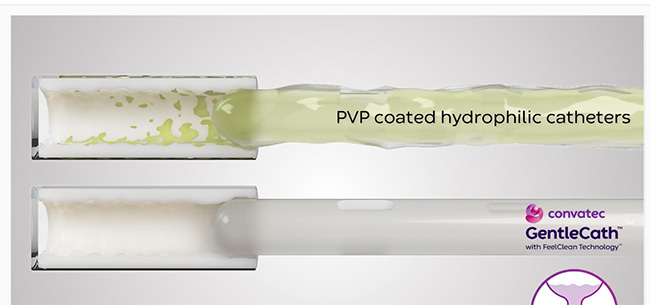
Most coated catheters have a PVP-based hydrophilic coating that swells to become lubricious when fully saturated. However, as hydration in the coating reduces, the catheter’s lubricious surface transforms and becomes sticky. This stickiness causes the coating to adhere to the urethral lining during use (Fader et al, 2001) (Figure 1).  

Why should you think about the urethral lining?
Figure 1. PVP-based coating sticks to the lining of the urethra, whereas in vitro studies show that GentleCath’s integrated non-stick properties doesn’t stick to the urethral lining or leave sticky residue.

GentleCath’s FeelClean technology is 100% PVP-free, creating its lubricious surface without the limitations of traditional PVP technology. FeelClean Technology’s integrated non-stick properties consist of hydrophobic tail groups in the catheter’s wall and hydrophilic head groups on its surface. As pure water flows over the catheter’s surface, a fine and continuous layer of hydration is formed, making it lubricious without altering its physical properties.

The performance of this next-generation technology has been independently demonstrated by Queen’s University Belfast, where FeelClean Technology’s surface was shown not to stick to or tear tissue, unlike other well-known PVP-coated hydrophilic catheters. FeelClean Technology’s integrated surface also left no sticky residue in a series of agar tests with leading competitors.

For users, FeelClean Technology’s next-generation integrated hydrophilic surface is less likely to damage the urethra. Urethral damage can cause discomfort, pain and subsequent urinary tract infections. Users of GentleCath with FeelClean technology have reported a smoother and more comfortable experience.

In in vitro studies, 39% less force was required to start removing GentleCath (in vitro data on file), as well as improved cleanliness (ConvaTec Inc, data on file, 2018) and minimal mess (in vitro data on file). Overall, 90% of users rated GentleCath with FeelClean technology as better than their usual catheter for comfort during use (ConvaTec Inc, data on file, 2018).

References

Berendsen SA, van Doorn T, Blok BFM (2021) Trends in the use and costs of intermittent urinary catheters in the Netherlands from 1997 to 2018: A population-based observational study. Neurourol Urodyn. 40(3):876-882. doi: 10.1002/nau.24643

ConvaTec Inc (2018) A Multi-Centre Clinical Investigation to Assess the Performance of GentleCath™ Glide Intermittent Catheters. Study U378 GentleCath™ Glide Final Report. .

Fader M, Moore KN, Cottenden AM, Pettersson L, Brooks R, Malone-Lee J (2001) Coated catheters for intermittent catheterization: smooth or sticky? BJU Int. 88(4):373-7. doi: 10.1046/j.1464-410x.2001.02342.x  

Roberson D, Newman DK, Ziemba JB et al (2021) Results of the patient report of intermittent catheterization experience (PRICE) study. Neurourol Urodyn. 40(8):2008-2019. doi: 10.1002/nau.24786

Rognoni C, Tarricone R (2017) Intermittent catheterisation with hydrophilic and non-hydrophilic urinary catheters: systematic literature review and meta-analyses. BMC Urol. 17(1):4. doi: 10.1186/s12894-016-0191-1