From idea to publication: a guide for new authors  

Part 2: manuscripts


Chelsea Creak PhD
Senior Medical Writer 
Convatec

Publishing a manuscript is not reserved for experienced researchers or academics. As nurses working in clinical, educational and leadership roles, you have unique insights that can benefit colleagues across healthcare settings. Whether describing a successful improvement project, reporting research findings, presenting a case study, or sharing innovations in practice, publication provides an opportunity to disseminate knowledge beyond a local setting.
 

Why share your research?


Types of journal articles

 
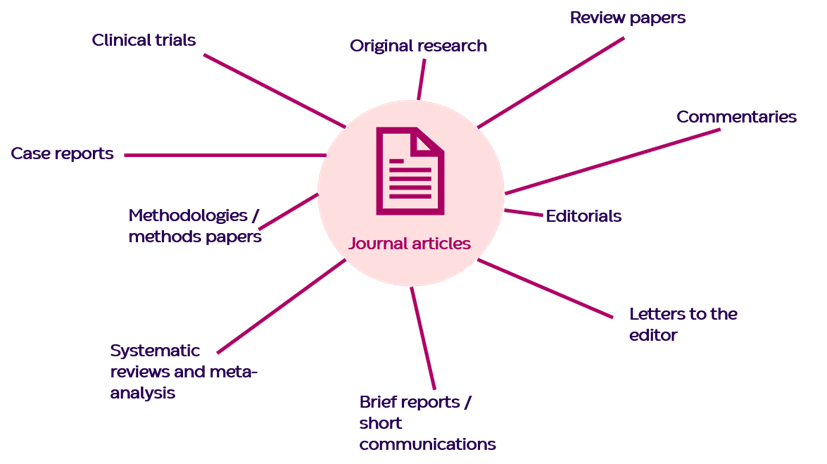
There are a wide range of journal article types which are considered for publication. These include, but are not limited to original research, case reports and case series, review articles, clinical trials, commentaries and editorials.
 Diagram showing types of journal articles including original research, case reports, review papers, clinical trials, commentaries and editorials

Journal selection


This is one of the most important strategic decisions in the publication process. Choosing an appropriate journal will increase the likelihood of acceptance, ensure it reaches the intended audience and maximise its impact.

The process of journal selection should begin prior to writing the manuscript, as journals have different requirements when it comes to document structure and reporting.

To help you find suitable journals to target:
  • Look at where papers covering similar topics have been accepted for publication
  • Use journal-finding tools (e.g. those offered by Elsevier, Wiley and Springer).
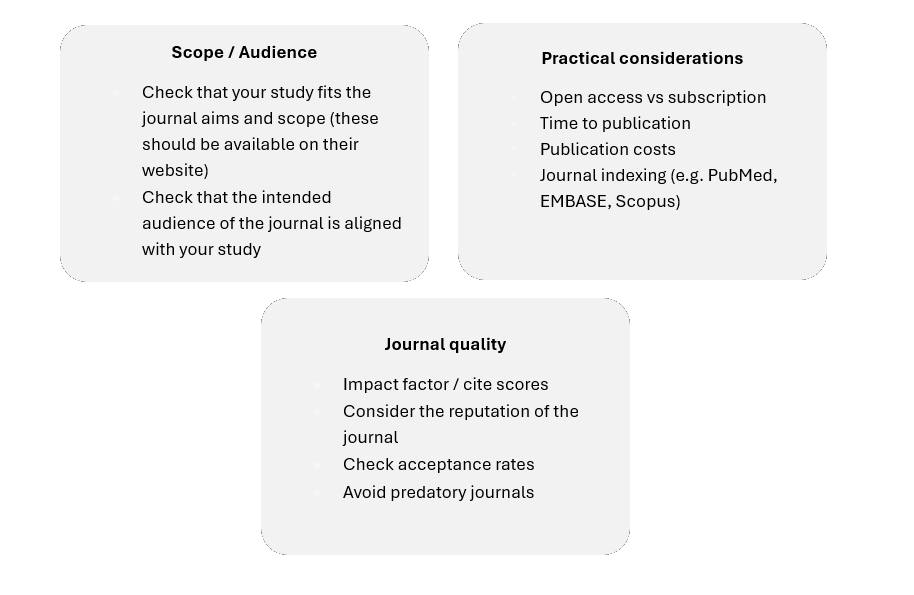
There are several key factors to consider when selecting a journal to submit your research to. These include:

Key factors to consider when selecting a journal

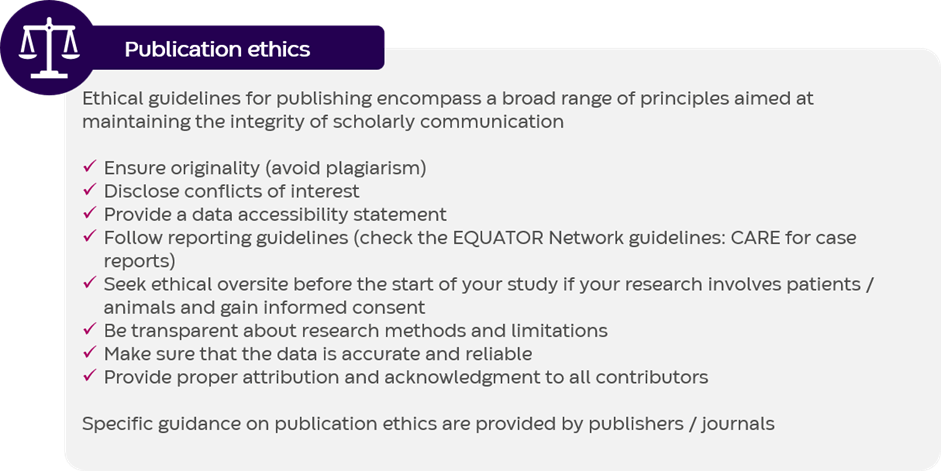
Publication ethics


Publication ethics guidance

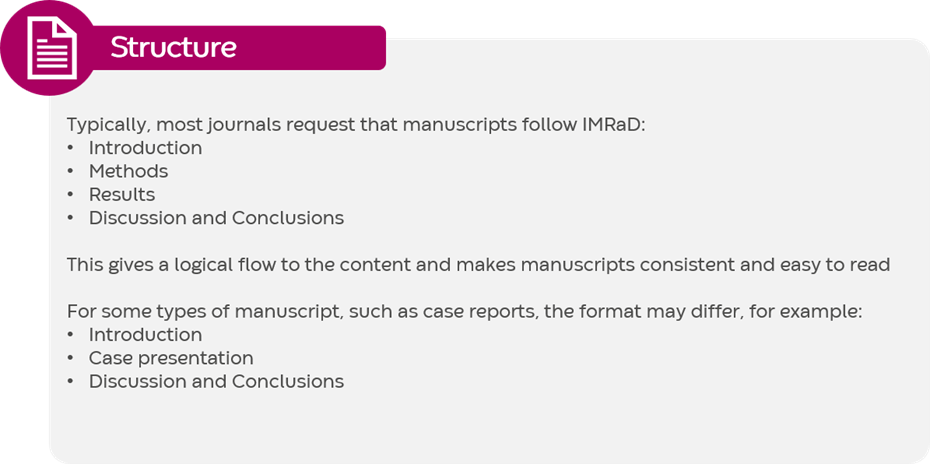
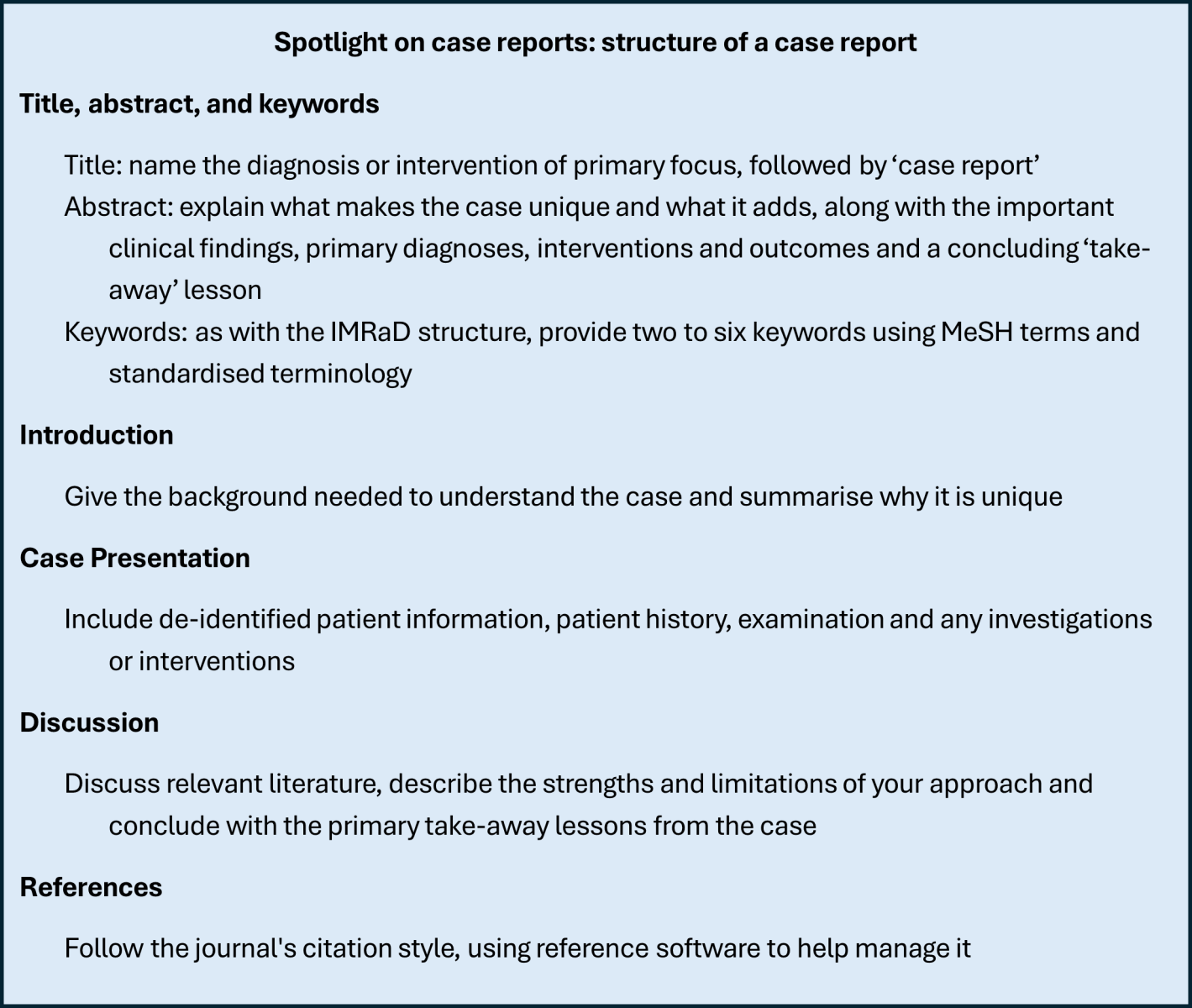
Anatomy of a manuscript


The structure of a manuscript following IMRaD

Authorship


Authorship should be discussed and agreed prior to manuscript development. All authors should meet the International Committee of Medical Journal Editors (ICMJE) authorship criteria:
  1. Substantial contributions to the conception or design of the work, or the acquisition, analysis, or interpretation of data; and
  2. Drafting the work or reviewing it critically for important intellectual content; and
  3. Final approval of the version to be published; and
  4. Agreement to be accountable for all aspects of the work, ensuring that questions about the accuracy or integrity of any part are appropriately investigated and resolved.
Anyone who contributed to the study but does not meet all four criteria should be recognised in an ‘Acknowledgements’ section of the manuscript rather than listed as an author.

Title, abstract, and keywords

 
  • Title: convey the main topic of the study, be concise, and highlight the importance or novelty of the work
  • Abstract: provide a short summary of the manuscript, usually around 250 words, answering the following questions: what was done, why it was done, what was found, and why the findings are useful and important?
  • Keywords: two to six words (depending on journal) that will help people find your publication. Use MeSH terms and standardised terminology

Introduction


  • Give the reader the background needed to understand the study and the reasons for the publication, note that this is not a literature review
  • Keep it well balanced, current and relevant
  • Specify the aim of the study

Materials and methods


  • Describe how you conducted the study, with enough detail that others could reproduce it
  • Use subheadings to separate out the methods

Results


  • Simply state what was found, without interpretation
  • Include figures and tables
  • Provide the results of any statistical analyses

Discussion


  • Interpret your findings in the context of existing literature
  • Describe any limitations and future research opportunities
  • Discuss what the results mean for researchers/patients/healthcare professionals
  • State the main conclusions at the end of the discussion

References

 
  • Follow the reference and citation style of the journal
  • Reference software (e.g. EndNote, Mendeley, or Zotero) can help

Publication ethics guidance

Cover letter


Some journals require a cover letter when submitting your research. This is a brief letter to the journal editor that accompanies your manuscript submission. It usually includes the manuscript title, article type, a short explanation of why the topic is important, why the manuscript fits the journal and confirmation that the work has not been submitted elsewhere.
A simple structure for a cover letter would be:
  1. Opening: state the manuscript title and article type
  2. Why it matters: briefly explain the importance or relevance of the work
  3. Why this journal: explain why the manuscript fits the journal’s aims and readership
  4. Declarations: confirm originality that it has not been presented elsewhere, or provide details or any conferences where the study has been presented
  5. Closing: thank the editor for considering the submission

Title page


Most journals request a title page alongside the main manuscript. It usually includes the title of the manuscript, the list of authors and their affiliations, contact details for the corresponding author, funding information and a conflict of interest statement.
 

Submission process


Before submitting your work, make sure you have all the final files required by the journal (e.g. the main manuscript, title page, cover letter, figures, tables) and double check them against the journal’s submission guidelines. In addition, ensure that you have final approval of all authors listed on the manuscript that they are happy with the manuscript.

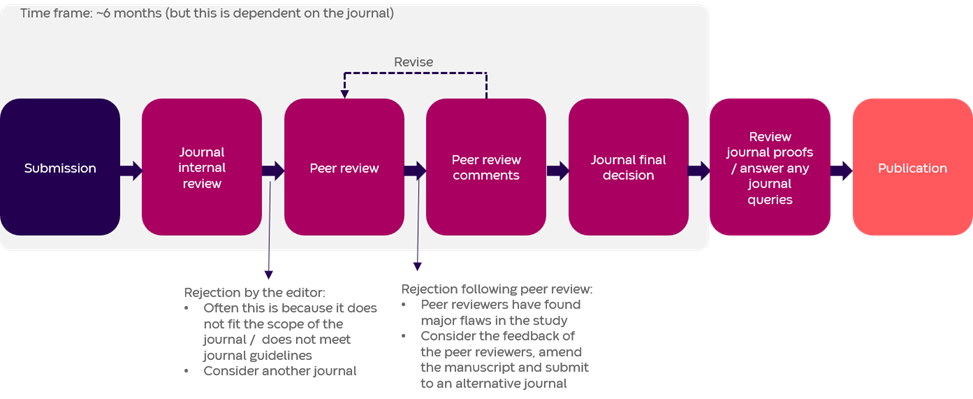
When you submit your manuscript, the journal will first check that the manuscript meets the scope and submission requirements. It may then be sent on for peer review. Peer reviewers are experts in the field who will assess your manuscript and provide feedback on its suitability for publication, quality, relevance and methods. If approved, you will likely receive comments from the peer reviewers that need to be addressed before publication.

Time to publication from submission differs between journals and from manuscript to manuscript, but six months is usually a good approximation.

The structure of a manuscript following IMRaD

FAQs for manuscripts and publication

How do I know whether my research/idea is suitable for publication?

A suitable idea usually:
  • Addresses a clear question
  • Fills a knowledge or practice gap
  • Offers learning opportunities for others
  • Is supported by appropriate data, evidence or experience
 

What is a journal Impact Factor?

This is a citation-based metric that evaluates the relative importance of journals within a given field by averaging the number of times an article in a journal has been cited over a recent period, usually two or five years.
 

What is a predatory journal?

Predatory journals are also known as fraudulent, deceptive or pseudo-journals. These are journals that claim to be legitimate but misrepresent their publishing practices.
Common forms of predatory publishing practices include:
  • Falsely claiming to provide peer review
  • Hiding information about Article Processing Charges (APCs)
  • Misrepresenting members of the journal’s editorial board
  • Sending aggressive email invitations
  • Poor website quality
  • Promises of guaranteed or unusually fast publication
 

Can I submit the same manuscript to more than one journal at once?

No, simultaneous submission is not allowed.
You should submit to one journal and wait for a decision before submitting elsewhere.
 

What should I do if my manuscript is rejected?

Rejection is common, so do not take this personally.
  • Read the feedback carefully
  • Revise the manuscript if needed
  • Consider submitting to another suitable journal
 

What is an Article Processing Charge (APC)?

This is a fee that some journals charge to publish an article, particularly open-access articles.