The enhanced Prescription Management Service from Amcare by Convatec: what you need to know

Following last month’s article which looked at how Amcare by Convatec’s HCP portal simplifies continence care with an efficient referral process and comprehensive service, you can now find out how the enhanced Prescription Management Service from Amcare by Convatec can support patient care while optimising NHS resources.

The NHS is under immense pressure. This leads to a cycle of system-wide inefficiencies, leading to an overburdened, under resourced workforce which causes suboptimal patient outcomes and experiences.

In 2026, Convatec Interface found that ‘34% of intermittent catheter users have a reduced quality of life, with 47% having at least one UTI [urinary tract infection] in the last year’.

There are estimated to be 50,000 intermittent self-catheterisation (ISC) patients in the UK (Ramadan, 2023). The cost of managing these patients is £1191 per year, and they have seven nurse visits per year, one third of which are unplanned (Gage et al, 2024). Despite this, the NHS Plan (Department of Health and Social Care, 2025) asks the NHS to be ‘fit for the future’ and to transform into a digital focussed, patient-centred system.

The cycle of pressure on the NHS

What is the current situation for ISC patients?


In one Integrated Care Board (ICB) for example, which has a patient population of 1.2 million, there are 4,615 patients using catheters. A total of 2,144 of these are ISC users. Based on real life audit data on file, gathered by Convatec in 2026, it is likely that 80% of ISC users (1,715) will have never been reviewed, and 34% (729) will have had their quality of life significantly impacted as a result of their catheter.

What is a Prescription Management System?


A Prescription Management System (PMS) is a nurse-led, centralised prescribing service for continence products. It fits between hospital discharge and community care, and gives commissioners visibility and governance across the whole pathway. Data from NHS Bedfordshire, Luton and Milton Keynes ICB in 2025 shows that a PMS delivered a £93,990 reduction in cost in year 1, which was a 22% cost reduction. As well as this, using a PMS addresses a lack of patient reviews, over-ordering and stockpiling, poor product optimisation, GP workload, a lack of data for commissioners, and rising complications and preventable costs.
Amcare’s advanced PMS goes further than traditional PMSs. It is a centralised system, which allows the management and administration of prescriptions and supporting data-driven decisions. It gives clinical, personalised support that leads to better patient experiences and outcomes. It has been reviewed by the Countess of Chester Hospital NHS Foundation Trust as part of their PMS framework renewal and was found to offer exceptional quality of service design and delivery.

The benefits the enhanced PMS can bring to your ICB include system cost savings, improved formulary compliance, personalised care coordination, clinical assurance for patient self-care, regular appliance use reviews, and monitoring of patient experience and quality of life.

Amcare’s enhanced PMS supports your ICB to become ‘Fit for the Future’ with:
  • The Convatec me+ patient support programme, which provides enhanced, personalised communication and support
  • Monitoring prescribing trends to ensure compliance and cost effectiveness
  • Data-driven decision support for what you need to deliver in your ICB, with measurable outcomes
  • Personalised support to ensure patients get products that work best for them
  • Direct, specialist nurse support for holistic patient care.


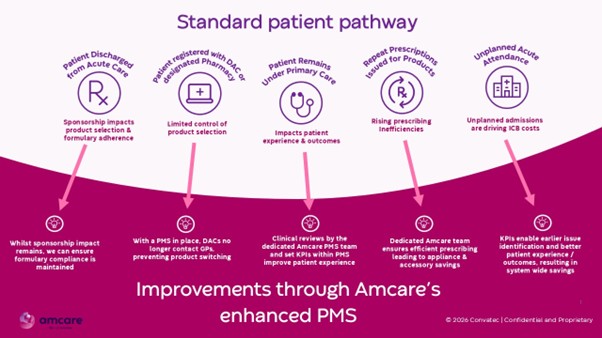
Figure 1 illustrates the ways in which Amcare’s PMS improves on the standard patient pathway.

Case studies: PMS in action


Case study 1 – preventing and reducing risk of UTIs


Patient A had been using nine catheters per day but had only been prescribed 150 per month and had avoided requesting more supplies. This shortfall led to the reuse of catheters during the last week of the month, resulting in nine UTIs in 12 months, causing pain, discomfort and repeated courses of antibiotics.

Action: The prescription was updated to reflect actual usage, and was registered with Amcare for consistent supply and support.

Impact: This reduced the reuse requirement, which thus reduced the risk of UTIs and improved confidence in managing the condition safely.
 

Case study 2 – reducing stress and improving quality of life


Patient B had been catheter dependent since childhood. She faced stress and anxiety chasing prescriptions, collecting large quantities of catheters from the pharmacy and often having limited supplies.

Action: The patient was assigned to Amcare, the supply quantity was increased and home delivery was arranged with access to free services.

Impact: Improved peace of mind with consistent and discrete supply of catheter products. Patient B displayed new-found confidence in her care, explaining that this had been the first catheter review she had received since her discharge from urology services.
 

Case study 3 – correcting misunderstanding about catheter limits


Patient C self-restricted their fluid intake, in the belief that they were only allowed three catheters per day. Patient C had been supplied only 90 catheters per month, and such restriction had contributed to them developing three UTIs in 12 months.

Action: Patient educated on the importance of hydration and supply increased to 150 per month, to align with current usage.

Impact: Improved health outcomes and reduced risk of UTIs.
 

To find out more about how the PMS from Amcare by Convatec could help your patients and your service, please contact Claire Dodds (claire.dodds@convatec.com) or Jake Rose (jake.rose@convatec.com) or call 0800 88 50 50.

References


Department of Health and Social Care (2025) 10 Year Health Plan for England: fit for the future. https://www.gov.uk/government/publications/10-year-health-plan-for-england-fit-for-the-future (accessed 14 August 2026)

Gage H, Williams P, Avery M, Murphy C, Fader M (2024) Long-term catheter management in the community: a population-based analysis of user characteristics, service utilisation and costs in England. Prim Health Care Res Dev 25: e13. https://doi.org/10.1017/S1463423624000021

Ramadan F (2023) Intermittent self-catheterisation: the community nurse’s role in identifying and overcoming the barriers. Br J Community Nurs 28(5): 224–8. https://doi.org/10.12968/bjcn.2023.28.5.224